
Water source & treatment
Ottawa's river-water treatment includes coagulation, settling, filtration, disinfection, pH adjustment and fluoridation. Chloramine is used to maintain a disinfectant residual through the central distribution network. Britannia's 2025 annual report provides plant averages and ranges, including total chlorine and turbidity. The rural municipal wells have their own reports, so source confirmation is especially important when discussing hardness or selecting equipment for an Ottawa property.
What this means for your home
For central-system homes, discuss the actual goal: drinking-water taste, a specific measured substance, or household plumbing concerns. Where chloramine reduction is desired, match equipment to that reduction claim and its required flow and contact time. For rural wells, establish hardness and other relevant parameters from the correct system report or laboratory sample. A river-water plant average is background information, not a diagnosis of a private well.
Profile scope
Central urban water system; rural communal wells and private wells are distinct supplies.
Sampling context
- Turbidity: 0.04 NTU. Britannia treated-water annual average, 2025; reported range 0.03–0.09 NTU, 725 samples. Not an Ottawa-wide household result. Source report
- Total chlorine: 1.82 mg/L. Britannia treated-water annual average, 2025; reported range 1.33–2.20 mg/L, 1,446 samples. The central distribution system uses chloramine. Source report
- Fluoride: 0.68 mg/L. Britannia treated-water annual average, 2025; reported range 0.57–0.74 mg/L, 724 samples. Source report
Official sources
- City of Ottawa — Britannia Annual Drinking Water Quality Report (2025)
- City of Ottawa — Municipal well systems
Photograph credit
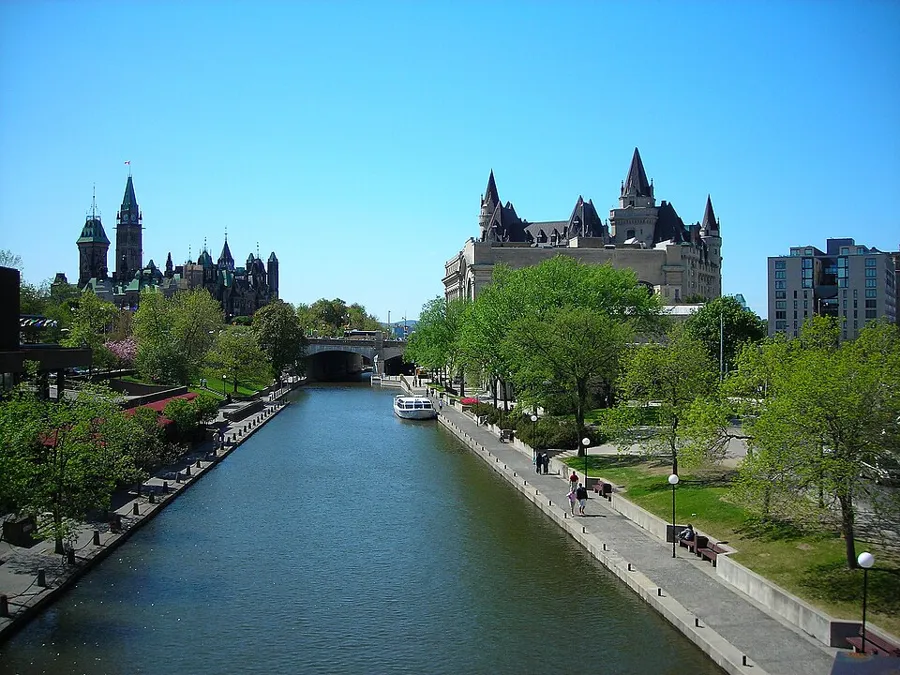
Rideau Canal approaching Parliament Hill in Ottawa, Ontario. Hussein Abdallah · Wikimedia Commons. CC BY 2.0. Resized and converted to WebP; may be displayed cropped.